

Courageous Conversations About Our Schools Podcast
Our podcast brings people together for respectful conversations about today’s most contentious issues affecting our schools.
Episode Directory
Find your favorite podcast episodes by topic, guest, or category.
Search by Category
-
When the Left and Right Actually Listen: Rick Hess and Pedro Noguera (Ep. 55)
Why Pushing Harder Makes People Resist More — with Elena Aguilar (Ep. 54)
The Cost of Silence: Why Good People Don’t Speak Up (Ep. 53)
An Alternative to “Knock it Off!” when Students Fight (Ep. 52)
From Strangers to Connection: A Day That Changes Everything (Ep. 51)
Why Connection—not Control—Is What Schools Need Now (Ep. 50)
"30 for Us" is Breaking Bubbles and Bridging Student Divides (Ep 49)
The Future of California’s High School Ethnic Studies Course (Ep 47)
Are Your Schools Prepared for ICE Raids? (Ep. 46)
Crossing Divides: How Schools Can Help Close America's Perception Gaps (Ep. 45)
Bruce Wasser Helped Students Stand Up For Principle. Do We Want More Teachers Like That? (Ep. 43)
The Shoe Club: Walking Towards Empathy and Connection in a Michigan School (Ep. 42)
From Hate to Dialogue: A Conversation with Daryl Davis, “Klan Whisperer” (Ep. 41)
Character Education is Essential (and Unavoidable). How To Do It Well (Ep. 39)
The Transformative Power of Curiosity - A Conversation with Scott Shigeoka (Ep. 38)
Why These Students Are Rejecting Contempt and Embracing Dignity (Ep. 37)
Schools Are Abandoning DEI. How a Different Approach Can Preserve It (Ep. 35)
Teachers Are Afraid to Talk About the 2024 Election (Ep. 34)
Meet Aaron Stark - Almost a School Shooter (Ep. 32)
Rich Harwood Rocks My World! (Ep. 29)
Middie Rising - A City Unites and Defuses a School Culture War (Ep. 3 of 3)
Middie Rising - A City Unites and Defuses a School Culture War (Ep. 2 of 3)
Middie Rising - A City Unites and Defuses a School Culture War (Ep. 1 of 3)
Bridging Youth Divides Through Morning Classroom Conversations (Ep. 25)
A Conversation with Daniel Buck- Defender of the Education Culture Wars (Ep. 23)
When Homeschooling Fails Should the Government Step In? (Ep. 21)
A Courageous Conversation with a Transgender Educator (Ep. 20)
Can Educators Prevent Racism in Schools? Diverse Perspectives, Lively Conversation (Ep. 17)
Thriving in Turbulent Times: Why Social Emotional Learning (SEL) is Essential (Ep. 15)
The Latest Culture War Dustup: Balancing Parent Rights with Student Rights (Ep. 14)
Taking a Stand Against Antisemitism in Schools (Ep. 13)
Overcoming Toxic Polarization in our Schools with Peter Coleman (Ep. 12)
Political Opposites Square Off on Schools, Gender, and Sexuality (Ep. 11)
Book Bans Exposed: Who Decides What Students Can Read? (Ep. 10)
Calming the Culture Wars in our Schools with Journalist Monica Guzman (Ep. 9)
Weston Brown's Story: A Family and School Tragedy (Ep. 8)
Forbidden Topics: Are Schools Hiding the Truth from Students? (Ep. 7)
Taming the Culture Wars with Journalist Amanda Ripley (Ep. 6)
Gender and Sexual Identity in Schools: A Battle at the Epicenter of the Culture Wars (Ep. 4)
High School Students Weigh in on Race. Are their Elected Officials Listening? (Ep. 3)
How Students Learn about Race and Racism is Dividing Our Country (Ep. 2)
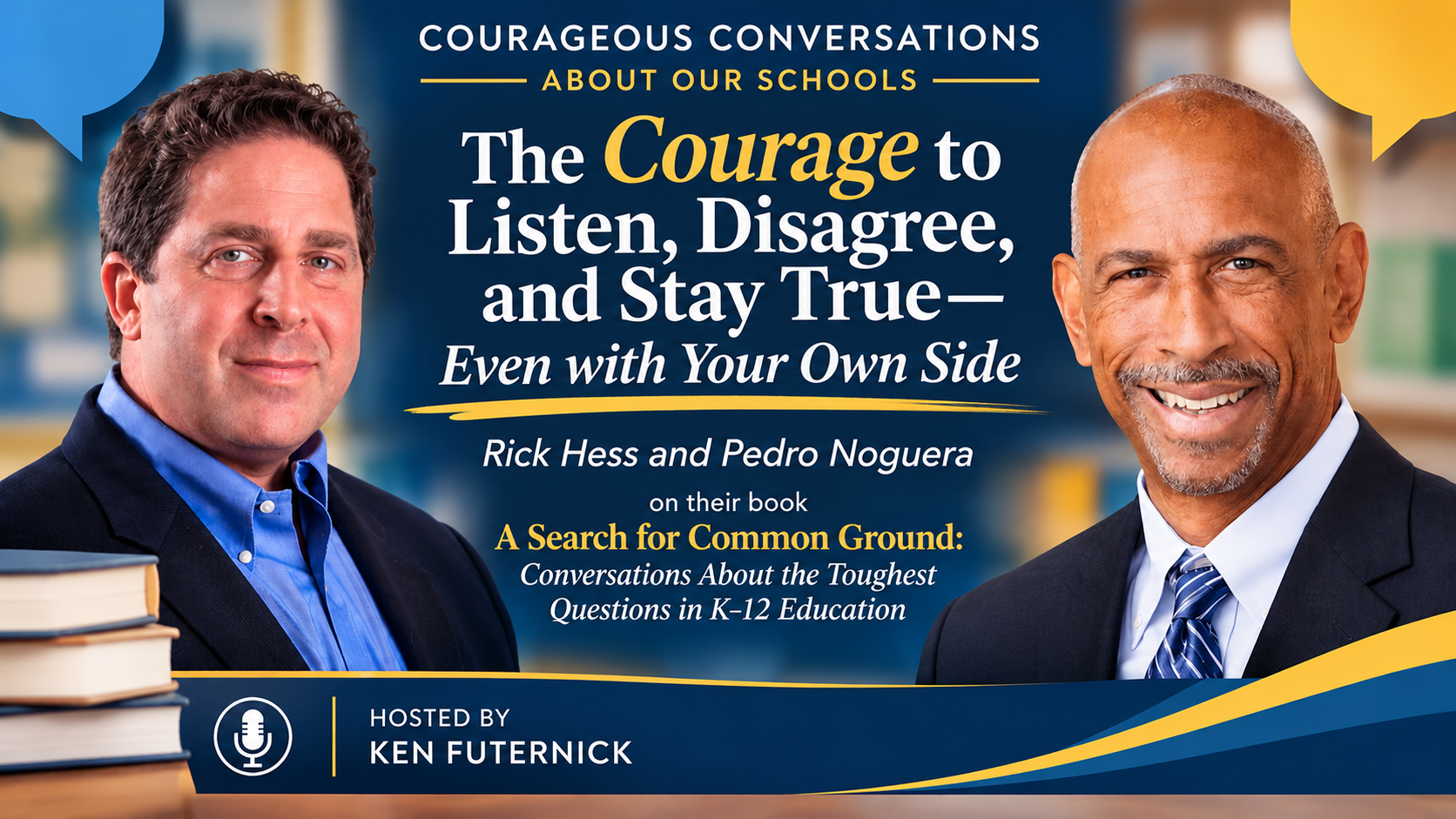
When the Left and Right Actually Listen: Rick Hess and Pedro Noguera (Ep. 55)
This podcast is about courage - courage to listen to people we don’t agree with, courage to challenge our own friends.
In this episode, host Ken Futernick speaks with two influential education thinkers from opposite sides of the political spectrum about their book A Search for Common Ground: Conversations About the Toughest Questions in K-12 Education. Instead of trying to win arguments on issues like school choice, standardized testing, or how history should be taught, they set out to listen and see what they could learn from one another.

From Strangers to Connection: A Day That Changes Everything (Ep. 51)
What if just six hours could transform how students see each other—and themselves? In this powerful episode, we take you inside Breaking Down the Walls, a high school workshop where simple conversations evolve into moments of deep vulnerability, empathy, and connection.

Why Connection—not Control—Is What Schools Need Now (Ep. 50)
In this episode, Ken Futernick sits down with Mike Walsh—widely known across California education circles as a master human connector—to explore how schools can build trust, strengthen relationships, and create communities where both adults and students truly belong.
Drawing on decades of experience as a school board leader, facilitator, and student advocate, Walsh shares how meaningful change doesn’t begin with answers, but with better questions—and with the courage to step aside so others can connect with one another.

The Extraordinary Transformation of a City and Its Schools—Part 2: Renewed Hope Leads To Tangible Change
In Part 1, we heard how Reading, Pennsylvania, began to turn outward—listening to families, students, and educators to rethink what their school system could be.
In Part 2, we see what happened when a new mindset and civic culture shifted from data gathering and healthy conversation to concrete action.
The Extraordinary Transformation of a City and Its Schools—Part 1: Building a New Civic Culture
When the pandemic struck Reading, Pennsylvania, its school system was already under enormous strain. The Reading School District—the poorest in the state—served 16,000 students, many of whom faced daunting barriers long before COVID arrived. Hundreds were homeless. Thousands stopped showing up to class. Teachers and principals were stretched thin. Community trust was low. And after years of missed opportunities and stalled reforms, many inside and outside the district believed real improvement was impossible.
Part 1 of this two-episode series is a story about how that belief began to change.

Two Panelists on Opposite Sides of the Ethnic Studies Debate Want to Continue the Conversation (Ep 48)
In a live, online discussion we co-hosted with Braver Angels on September 4th, 2025, eight panelists discussed whether Ethnic Studies should be required for high school graduation, whether such a course should even be offered at all, or whether the content is likely to do more harm than good.
A particularly noteworthy moment occurred near the end when Niclole Bernstein, a panelist opposed to Ethnic Studies, expressed a desire to continue the conversation with Albert Camarillo, one of four panelists in support of the course. This episode captures the fascinating conversation that took place between these two panelists just two weeks later.

The Future of California’s High School Ethnic Studies Course (Ep 47)
Should high school students be required to take an Ethnic Studies course? Should such a course even be offered at all, or is the content likely to do more harm than good? These were the questions that a diverse group of panelists discussed in a live, online “fishbowl” discussion we co-hosted with Braver Angels on September 4th, 2025.

Are Your Schools Prepared for ICE Raids? (Ep. 46)
In this timely conversation, attorney Leo Tucker shares his expertise on preparing schools and communities for immigration enforcement actions that could separate children from their families. Tucker has developed a comprehensive, free guide called "Preparing for ICE Raids" that helps schools create rapid response plans to protect vulnerable students…

Crossing Divides: How Schools Can Help Close America's Perception Gaps (Ep. 45)
In this episode, host Ken Futernick speaks with James Coan, founder of More Like Us, along with high school students Landon and Deegan, about perception gaps in American society.
James explains how perception gaps are the exaggerated negative views we hold about people with different political beliefs. Research shows Americans across the political spectrum are actually more similar than they realize, but media, social platforms, and political systems often incentivize division.

When "Good Citizens" Disagree: An Educational Historian Weighs in on the Competing Visions for American Schools (Ep. 44)
In this Courageous Conversation, host Ken Futernick and Dr. Jonathan Zimmerman, a professor of History of Education at the University of Pennsylvania, delve into the heated debates surrounding American schooling.

Bruce Wasser Helped Students Stand Up For Principle. Do We Want More Teachers Like That? (Ep. 43)
In this episode, host Ken Futernick sits down with Bruce Wasser, a former history teacher whose life story is as inspiring as his teaching career. Bruce shares his poignant journey from being a conscientious objector during the Vietnam War to becoming a beloved educator who had a profound impact on his students. Listen as Bruce recounts the pivotal moments that shaped his life, including the influence of his high school basketball coach and the challenges he faced in standing up for his beliefs.

The Shoe Club: Walking Towards Empathy and Connection in a Michigan School (Ep. 42)
This story starts with a bag of shoes that helped a school community heal after the tragic deaths of two students. That story blossomed into a unique project called the “Shoe Club” that fosters empathy and breaks barriers in a Michigan middle school. The founder of the club and guest on this episode is Matt Hamilton, a 2025 Horace Mann and NEA Award-winning teacher from East Jordan Public Schools in Michigan.

From Hate to Dialogue: A Conversation with Daryl Davis, “Klan Whisperer” (Ep. 41)
How many of us would have the courage to have a conversation with someone who hates us? My guest, Daryl Davis, has done just that, not once, but for decades, with members of the Ku Kluz Klan and other hate groups, and many have renounced their ideology after getting to know him. A Black musician, Davis shares his unbelievable story driven by one powerful question: "How can you hate me when you don't even know me?" Prepare to be challenged to rethink how we and our students engage with those who seem the furthest from us.

Democracies Cannot Survive Without Quality Education. A Conversation with Author Brook Manville (Ep. 40)
American democracy cannot survive without well-functioning schools that enable students to become good citizens and that teach them to appreciate what it means to live under a system whose only boss are the people themselves. That’s the claim my guest Brook Manville makes in his new book, The Civic Bargain – How Democracies Survive.

Character Education is Essential (and Unavoidable). How To Do It Well (Ep. 39)
This episode is part of our series on our sister podcast, Teacher Stories, on what schools can do to help save our democracy. Guests include Dr. Marvin W. Berkowitz, McDonnell Professor of Character Education at the Center for Character Education and Citizenship at the University of Missouri at St. Louis; and Dr. Kashina Bell, Deputy Superintendent for the School District of University City in St. Louis, Missouri. Both talk about character education - what it looks like, how it's done, and why it's vital to our democracy.

The Transformative Power of Curiosity - A Conversation with Scott Shigeoka (Ep. 38)
Curiosity has been a common theme in this podcast. Conflict experts like my guests Amanda Ripley, Monica Guzman, and Peter Coleman say being curious and less judgmental is often a better way out of toxic conflict than making stronger arguments or presenting more facts. And, as we heard from our recent guest, Tim Shriver, it’s a much better alternative than treating one’s adversaries with contempt, which often makes matters worse. “Contempt only makes an enemy for your cause,” he says.

Why These Students Are Rejecting Contempt and Embracing Dignity (Ep. 37)
In our previous episode (Ep. 36), Tim Shriver says America’s widening political and social divides are, surprisingly, not due to our differences. “We’ve always had differences,” he says, “Contempt is the problem.” Shriver explains why treating others with dignity is more likely to produce the results we want and why contempt usually does the opposite.
In the current episode, Futernick interviews four college students who are ambassadors for Students for Dignity, an organization with over 25 chapters on college campuses across the county. Preston Brightwell, the founder of this organization, also participates.

Getting Students (and Adults) to Respect One Another’s Dignity - A Conversation with Tim Shriver (Ep. 36)
Tim Shriver is a member of the Kennedy family, Chairman of Special Olympics International, co-founder of UNITE, and a former teacher. In this wide-ranging conversation with host Ken Futernick, Shriver describes a tool he co-created called the Dignity Index, and he describes how educators are using it to address our widening political and social divides. “We built it because there's an issue in our culture, in our families, in our homes, and in our schools that we haven't paid that much attention to. And the issue is how we treat each other when we disagree.” The Index is a framework that allows students (and politicians and educators) to examine their interactions, with the goal of reducing contempt and promoting a sense of dignity toward others. “Most people think the problem is that we have such [great] differences in our country. Our view is that's not a problem,” Shriver says. “We've always had differences…Difference is not the problem…Contempt is the problem.”

Schools Are Abandoning DEI. How a Different Approach Can Preserve It (Ep. 35)
School mission statements across the county commonly included language about Diversity, Equity, and Inclusion. DEI training for educators was also common. But that’s changed in recent years as school culture wars erupted around the books students have access to: how students learn about history, race, and gender identity, and anything that smacks of “woke” ideology.

Teachers Are Afraid to Talk About the 2024 Election (Ep. 34)
One would think that schools are the perfect place for students to learn about elections. What better opportunity to use the critical thinking skills they’ve learned in making sense of what the candidates are saying and to distinguish credible information from what they often encounter on social and mainstream media. These skills would certainly serve them well after the election when there are sure to be protests, claims, and counterclaims about election fraud and tampering.
However, many teachers said they wouldn’t be discussing the 2024 election …